Thursday, April 8, 2010

Bali, Cambodia, and Thailand: September 28, 2009

All material including photographs are ©2009 Ronald Dunlap / Doglight Studios

This was our last full day in Bangkok and our last full day of this trip.

I found the buffet breakfast at the Aspen Suites to be excellent, especially once the wait staff got to know your tastes. I had the usual, eggs over easy, bacon, toast, pineapple juice, a couple of Danish, and a Diet Coke. As Ann finished her coffee, we discussed what to do, and she mentioned that she'd like to go back to Wat Po and get the full body treatment. I said that was fine, because the massage was done fully clothed.

We caught the shuttle down to Sukhumvit Road, where we hailed a cab. It took a little over 20 minutes to squirm through the morning traffic before we pulled up in front of the north entrance. You need to buy a ticket to get in even if you only want to go to the massage school.


We bought our tickets and were assigned to two masseuses whom we followed into the massage room. I was surprised at how crowded the room was. They found two empty beds and we went into the dressing rooms to change out of our pants and put on some of the loose-fitting, long-legged shorts that they provide.


They put your valuables in a flip-top compartment at the head of the bed.


I'm old, but I still go to Gold's Gym five or six times a week. My masseuse kept complaining that I wasn't flexible enough. I guess I was wearing out her hands. When she got to my back, she had to stand on me with all her weight to move things around a little. She was unhappy.

Ann finished first and started retrieving her valuables from the flip-top compartment. She didn't realize that it was only hinged, with nothing to dampen the movement. So once she let go, the lid fell shut with all the force of a gun shot. I had my eyes closed, and because the room was so quiet, it sounded like a bomb going off. Scared the crap out of everyone in the room. Score one for the uncouth Americans. I grabbed my stuff, tipped my masseuse, and got the heck out of there. Laughing once we were outside, we found the exit and made our way to the river.


We were looking for the Tha Tien dock that was close to the Royal Palace. As usual, there was a refreshment stand that caters to tourists. Purchasing some drinks, we found the ticket window, bought day passes, and took seats in the shade of the dock's awning. The next ferry was heading up-river so we got on. It's really pleasant just being on the river. Much cooler, and the breeze is so refreshing. Ann read in the booklet that Phra Athit dock gave access to the Banglumpoo section of Bangkok. This is supposed to be a sanctuary for backpackers and those traveling on a budget.


First thing I noticed is that there were tons of Westerners in every size and shape. There are lots of ads directed at them for home-stays, youth hostels, cheap hotels, and travel agents promising the cheapest airfares available. We walked around shooting anything that looked interesting for the next two hours. From clothing stores to a large Buddhist shrine, we just snapped away. At 3:30 we'd had our fill and returned to the dock to catch the boat down to the lower end where we could hook up with the Skytrain. At this time of day the boats were packed with commuters, so we ended up standing the whole trip.


We needed to get back to the hotel early so we could pack and relax a little before the traumatic effort of returning to our normal lives.

We had an early dinner and then I went down to the reception desk to settle the bill and reserve a car to take us to the airport tomorrow.

I'd left laundry out for this morning and it was back in time to put into my bag as I packed and repacked.

Lights out at 10:00.

Tuesday, April 6, 2010

Bali, Cambodia, and Thailand: September 27, 2009

All material including photographs are ©2009 Ronald Dunlap / Doglight Studios

We were up early again and did our usual routine. Out front of the hotel the only taxi at the cab stand was the same guy that had driven us yesterday. As we were walking past, he came over to talk to us. He knew we were unhappy with yesterday's outing and offered to take us to Ayutthaya for half price. I said we'd do it if we could pay him at the end of the trip, if we were satisfied.


Ayutthaya was the ancient capital of Siam between 1351 to 1767. It faded into history as a result of being sacked by a Burmese army. Today, it is still one of the spiritual centers of Thailand and is popular with both tourists and the Thai people. Ayutthaya is located 40 minutes north of Bangkok, and we made good time, getting to the outskirts just before 8:30.

The city is big, and you can't hope to see it all in one day. The usual plan is to visit four temples, spending thirty minutes to a full hour on each one.


The first temple, Wat Yai Chai Mongkol, was built in 1357 and is still an active religious center. We bought our tickets (THB 50 each), and made our first encounter, the Reclining Buddha. It was early, so there weren't many visitors to disturb the beauty of the place. The Reclining Buddha was restored in 1965 and is partially covered by a large ruffled orange robe. His face looks spotted, but close up one can see that it's patches of gold leaf. The devoted buy the gold and annotate the statue with it. Maybe in a hundred years the whole face will be covered.


From there, we went to the main stupa with its many Buddhas. I climbed up and spied a garden that looked very interesting. I found my way down and walked to it -- it had residences for the priest that lived there, and was very lovely.


The building that houses the main Buddha was crowded with worshippers bringing offerings and praying. I waited at the side while Ann explored the interior. I'm a little shy that way.


Our second temple was Wat Mahathat. It's more of a ruin than any of the other sites; there isn't much activity other than tourists walking through. The Buddha's head is surrounded by tree roots; it is used in much of the advertising for Ayutthaya. Decades ago, the head had a sloppy restoration that spoiled its look, making it cartoony. Outside of that, I couldn't find much to recommend a visit here. There is one building that had what looked to be attached papyrus columns, giving it a somewhat Egyptian feel.


On the way to the third temple, we stopped at an elephant ride concession to grab a couple of shots of the elephants carrying clients out to visit the surrounding monuments.


Temple three was Wat Phra Si Sanphet. This was a combined working Buddhist temple and much older Buddhist ruins; at least that's what I think. There isn't much specific information about the temple, but its image graces the tickets of all the sites in Ayutthaya.


I walked around the working temple and found the entrance gate to the older section, where I paid my THB 50 entry fee. A local camera club was conducting classes at the front, so I moved around to the back and climbed up one of the three stupas. I got into a door-like recess and shot the stupa across the way. Someone had decorated the area with Bird of Paradise flowers. I had to watch my footing, as there was a gaping hole a couple of steps in back of me that I could have fallen into.


I shot for a while, then headed back to the taxi. On the way, I walked past a beautiful young lady who was playing a musical instrument with a sign asking for donations for education. I wasn't sure if it was for education in general or her education. I took a couple of pictures of her, but I could see that she was a uneasy, so I made my $1 donation and continued on. It took Ann another 20 minutes to finish her shooting. While I waited, I just relaxed in the taxi, which was parked in the shade of a very large tree.


The last temple, Wat Chaiwatthanaran, was built in 1630 as a memorial to King Prasat Thong's mother. Fronting the Chao Phraya River, this is one of the most popular destinations in Ayutthaya. At one point in the city's history, scavengers beheaded some of the Buddhas, carting them off for sale, and stole bricks from the temple's superstructure. In the late 1980s the government of Thailand stepped in and began restoring the place. Today, this is a UNESCO World Heritage Site. They are helping to fund a moveable concrete barrier to protect the site against flooding when the river rises above normal levels.


This had been a much better experience than yesterday -- we hadn't been taken advantage of -- and we were feeling a bit better. On the way back to Bangkok, we asked the driver to drop us off at Jim Thompson's house, which had been converted to a museum-like experience of a traditional teak house. Jim Thompson was an American expatriate who single-handedly revived the Thai silk textile industry in the 1950s and 60s. A lot of mystery surrounds this ex-military intelligence officer who disappeared on Easter in 1967 in the Cameron Highlands of Malaysia. No one's sure what happened, but there are lots of theories.


We got there and found that you have to purchase a ticket for a tour of the house and then wait until your group is called. We decided to get lunch in the restaurant but missed our tour time in the process, so after lunch we went into the silk shop. I got a scarf similar to the one I had bought in Siem Reap, as it helps with cushioning the camera bag strap. Ann bought a couple of silk pieces as gifts.


It was early afternoon as we walked up to Sukhumvit Road and turned east towards our hotel. We did some shooting of the Siam Paragon shopping center and the street scenes, then hailed a taxi and went back to Patpong to get some shots of the architecture in the afternoon light.

Friday, April 2, 2010

Bali, Cambodia, and Thailand: September 26, 2009

All material including photographs are ©2009 Ronald Dunlap / Doglight Studios

We were up early and had another great breakfast. We walked out of the air-conditioned hotel into another hot, humid Bangkok morning. The overcast skies were a little gloomy, but I hoped for the best.

I'd arranged to have one of the cabs at the taxi stand take us to the "floating market" for THB 15,000 ($47). We were hoping for some great pictures. The driver could tell we were a bit tired and told us we could nap a bit because the market was an hour or so south of Bangkok.

Travel Info: We later found out that there are eight or nine different floating markets and that the driver takes you to the one where he gets the biggest commission, not necessarily to the one that's the most authentic or photogenic.


We'd been riding along for about 45 minutes when the driver asked if we'd like to stop at a special village market on some train tracks that was becoming a major attraction. He said the train's arrival is spectacular.

The cab parked a couple of blocks away, and we walked to the market. According to the schedule, the train was supposed to be there in about 15 minutes. While we waited, we decided to walk around shooting the market vendors and the other folks, like us, waiting for the train. Surprisingly, there were a lot of school students here waiting for the spectacular to happen. I wondered of what educational value this might be. The train finally showed up after 45 minutes.

There's a spotter, in a blue shirt, up the tracks who warns the vendors that the train is coming. Within minutes, the vendors have to raise their awnings and move their goods away from the tracks until the train passes by. Once the train passes, the stands are back in business within seconds.

A lot of waiting around for a few seconds of action.

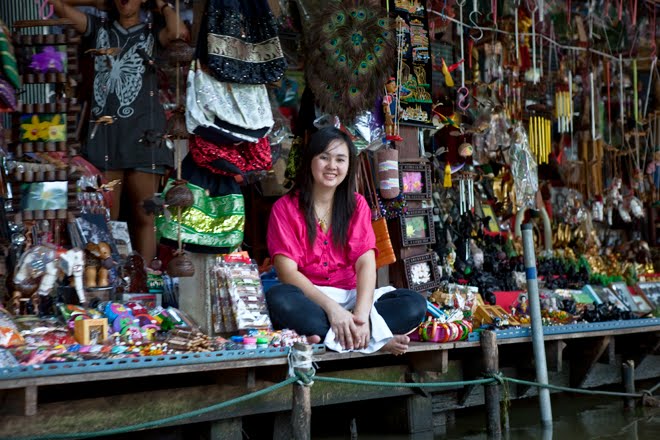
I don't know what I imagined, but this floating market experience wasn't it. The cab pulled up in front of a boat service where you have to bargain for a boat to take you to the market. Despite all our efforts, we'd been caught in another Thai tourist trap. We had to bargain with the man who owned the boat service and finally ended up paying half of what he wanted for two-thirds of normal time. In other words, he wanted $60 for an hour and a half, and we ended up paying $30 for an hour. But if I had known what was ahead, I'd have just gone back to the hotel.


It was like the jungle boat ride at Disneyland. The waterways were concrete canals that interlinked with other canals. It took a while to get to the market area, where the tourists outnumber the locals three or four to one. I was only able to get a couple of really nice shots, because there were just too many tourists to get a clear shot of anything interesting. Lots of souvenirs and everything marketed toward visitors.


When we got back, we tipped the boat captain a little, but as far as I was concerned, this was just a tourist trap. This had been an expensive trip and not much to show for it.

The driver could tell we were a little pissed. Instead of going back to the hotel, we asked him to take us to the Chatuchak market. It's a weekend market that covers over 35 acres, with over 15,000 stalls and more than 200,000 visitors. This place has everything, it just takes a while to find it, so you will need to have patience. He dropped us off and pointed out where the Skytrain station was. We got out without tipping him; we weren't too happy with this guy.


Travel Tip: This place is hot, really hot. You need to bring water and a hat. This place is also crowded, so you need to keep track of your valuables. I suggest keeping your money out of sight.


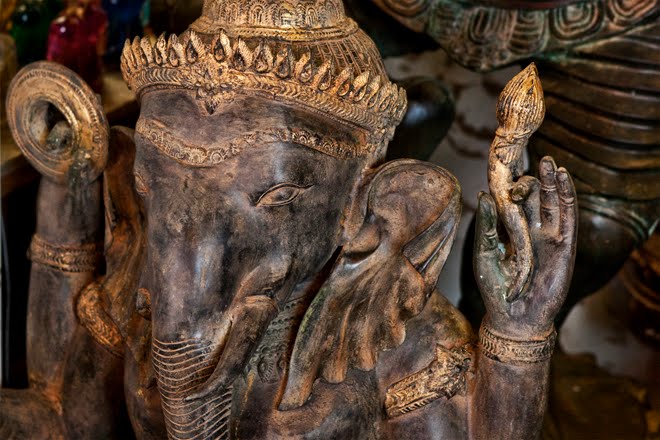
The market is a giant place, and the layout of the alleyways is unpredictable. I found it very hard to figure out where the different sections were located. After about 30 minutes we found the antiques section. There were lots of wonderful things here, but not many bargains. I could have spent a lot more time here if we hadn't needed to head back for the Skytrain.


The train was crowded, and Ann and I got separated just by the crush of the crowd. We rode down the line five stops and had to push our way out, making it to the platform just as the doors were closing.


We got back to the hotel a little after 4 p.m. and rested for a bit, then decided to go to Patpong, one of Bangkok's red light districts. We just wanted to take a surface look at the place, not get drawn in like so many men of my age, looking for a glimpse of their youth and a little love, even if you had to pay for it.


Besides being a center for strip clubs and bars, Patpong is also a night market. When we arrived, the main thoroughfare was being converted into a series of lanes, and people were selling everything from sunglasses, belts, and watches to custom jeans and sex toys.


I mentioned in an earlier episode that when you're shooting and concentrating on your composition, it's easy to lose track of where you are. And that is just what happened to Ann and me. One minute she was right behind me, and the next she was nowhere to be seen. Thirty minutes later, when I'd almost given up trying to find her, I sighted her in front of a 7-11 store. It was a joyous reunion, and we celebrated by buying some junk food.


I'd had enough for one day. Just one more task: bargaining for the taxi ride back to the hotel.